10 must-see spots on the Snæfellsnes Peninsula in Iceland

Exploring the wild west of Iceland – lava fields, seals, and our first F-road.

The Snæfellsnes Peninsula is a part of the island that is often overlooked, favoring instead the Westfords further north. It is, however, an incredible area to explore on your ring road journey, or even as a long day trip from Reykjavik.

The most western point of Iceland offers incredible landscapes, as this wild part of the island feels like it’s being constantly torn apart and reborn, with volcanoes spouting from the ground at every turn, lava fields stretching as far as the eye can see, and the Atlantic ocean crashing against its shores.

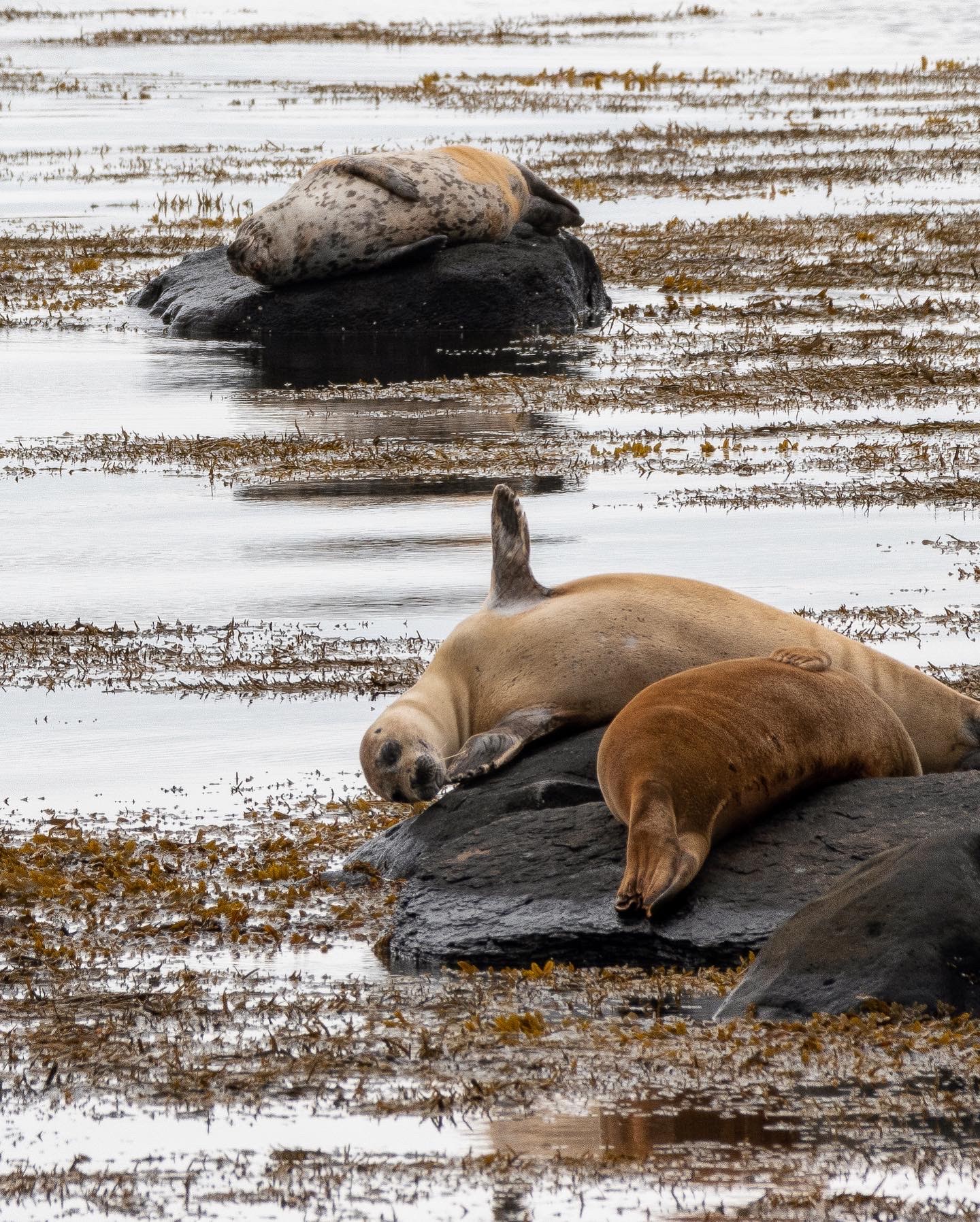
Although the area may sound harsh and desolate, it’s in fact teeming with life – the black lava fields are covered in lush green moss, and we’ll meet some friendly seals along the southern coast.

Our trip around Snæfellsnes took us to some more typical areas, but we also experienced some surprises along the way, like climbing a dormant volcano and taking our first drive through a steep, foggy F-road through a glacier.

So, here are my top 10 must-see stops on your journey across the Snæfellsnes Peninsula

  • Gerðuberg cliffs
  • Svörtuloft Lighthouse
  • Ytri Tunga Beach
  • Rauðfeldsgjá Gorge
  • Arnastapi
  • Snæfellsjökull National Park
  • Búðakirkja, the Black Church
  • Snæfellsjökull Glacier
  • Selvallafoss
  • The Ölkelduvatn Mineral Spring

Now, you may be thinking “hang on James…I don’t see Kirkjufell on this list!”, and rightfully so. If you don’t know, Kirkjufell is the most photographed mountain in Iceland, making it one of the tourist hotspots for the area. So, odds are you’ve probably come across this in your planning already, and if you haven’t, you’re sure to.

The mountain and its waterfall neighbor, Kirkjufellsfoss, are worth stopping at. The sheer size of the mountain and its perfect cone shape make it a unique place worth stopping at, and if you’re a photographer you can capture the iconic shot of the waterfall in the foreground and the mountain in the background.
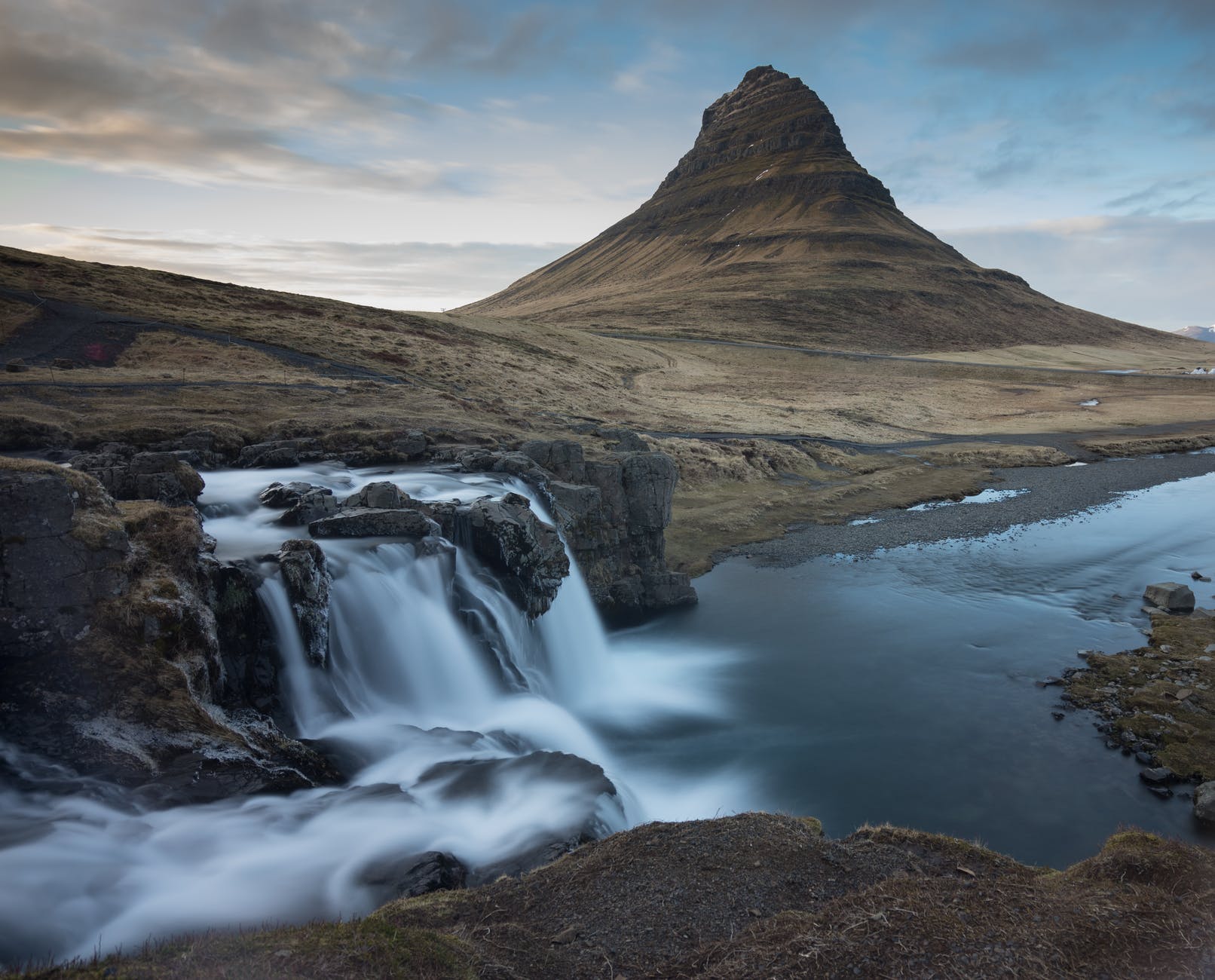
Photo by Pixabay on Pexels.com

For me, that’ll have to be a stop on my next trip to Iceland, as we favored Selvallafoss instead, a neighboring waterfall with an incredible panoramic view of the sea, lava fields, and extinct volcanoes.

Driving from Reykjavik to the peninsula should take you just over a couple of hours if you follow route 54. Although we did stop a couple of times to take in the view, the real treat comes when you reach the peninsula, starting with the Gerðuberg cliffs.

Gerðuberg cliffs

Have you ever wondered what cooling lava pushing up through the earth in evenly spaced centers and cooled over hundreds of years looks like?

Me neither.

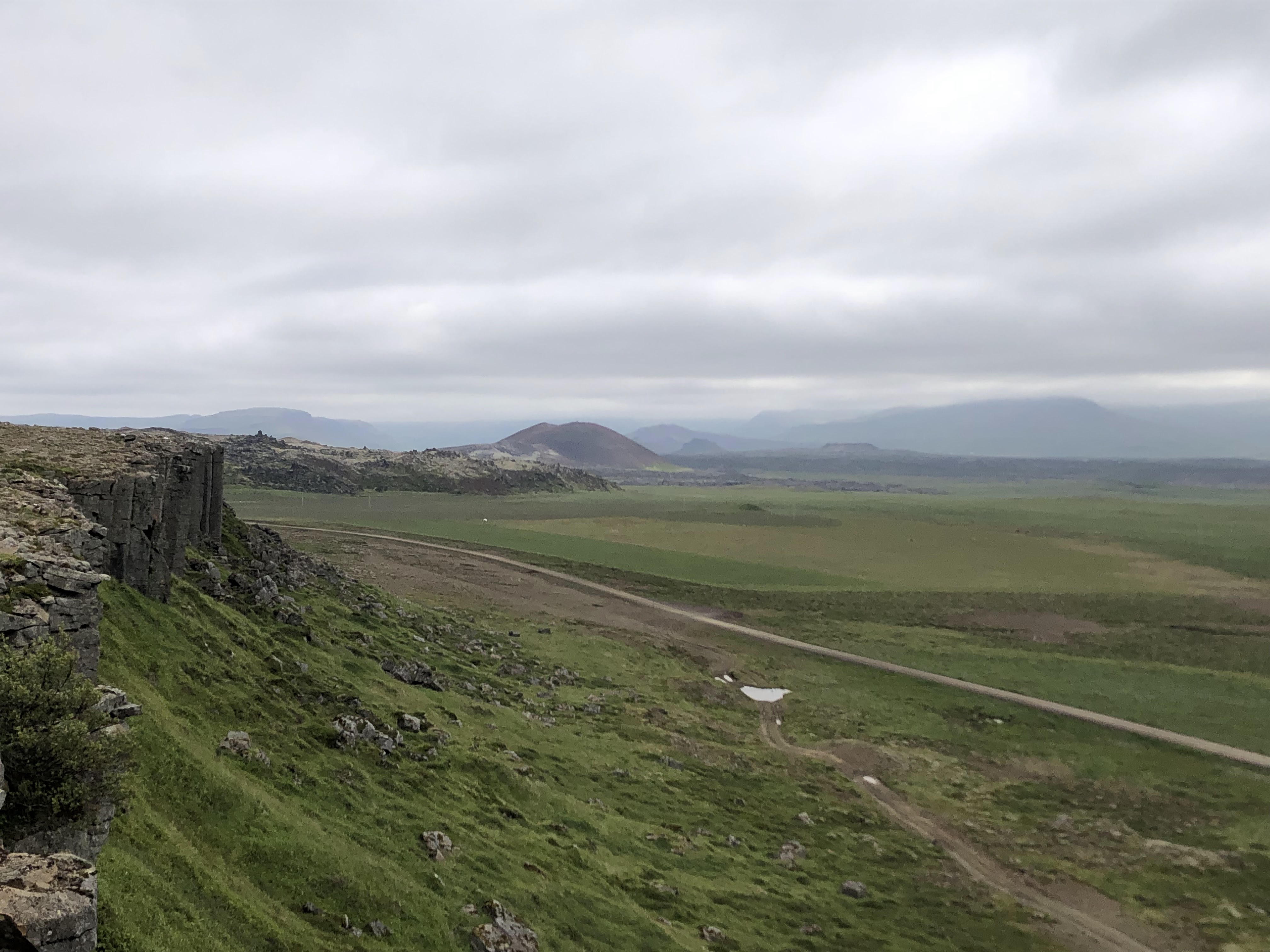
Or at least, I didn’t use to until I came across these intriguing, hexagonal columns reaching up to 15 meters high at Gerðuberg cliffs. These kinds of geological structures aren’t unique to the area, you’ll often see them across the island with some particularly beautiful examples like Svartifoss and Aldeyjarfoss, Studlagil canyon, and along the coastline of Arnarstapi as we’ll see later on.

The volcanic fields
covered in green moss with the
red hills popping out of the earth.

Gerðuberg cliffs
from the ground, basalt columns
reaching up to 15 meters high.
The Perlan Museum in Reykjavik has a very informative (and fun!) exhibit on this which is worth seeing if you want to fully understand some of Iceland’s geological marvels.

You’ll reach the cliffs through a short dirt road off route 54 (the main road that goes around the peninsula) that runs parallel to the cliffside. You should see a church in the distance, at the end of the road, and a narrow road that climbs the mountainside (more on that later).

Once you’ve parked, you’ll see a few footpaths you can climb if you want to stand atop the cliff and see the lava fields, but for me, the real beauty of this area is seeing the columns from their base. Although the cliff isn’t as monumental as the rift in Thingvellir, the unique structure is unlike anything I’d ever seen before and worth seeing on your way to the peninsula.

Now, if you’re feeling adventurous, you should continue along the road in the direction of the church, which takes you up behind the mountain and up onto an extinct volcano.

On your way up, you’ll pass the Ytri-Rauðamelskirkja church on your right as you climb the red slopes of the mountain, and after another 5 to 10 minutes of driving, you’ll find what looks like a parking area at the base of the volcano.
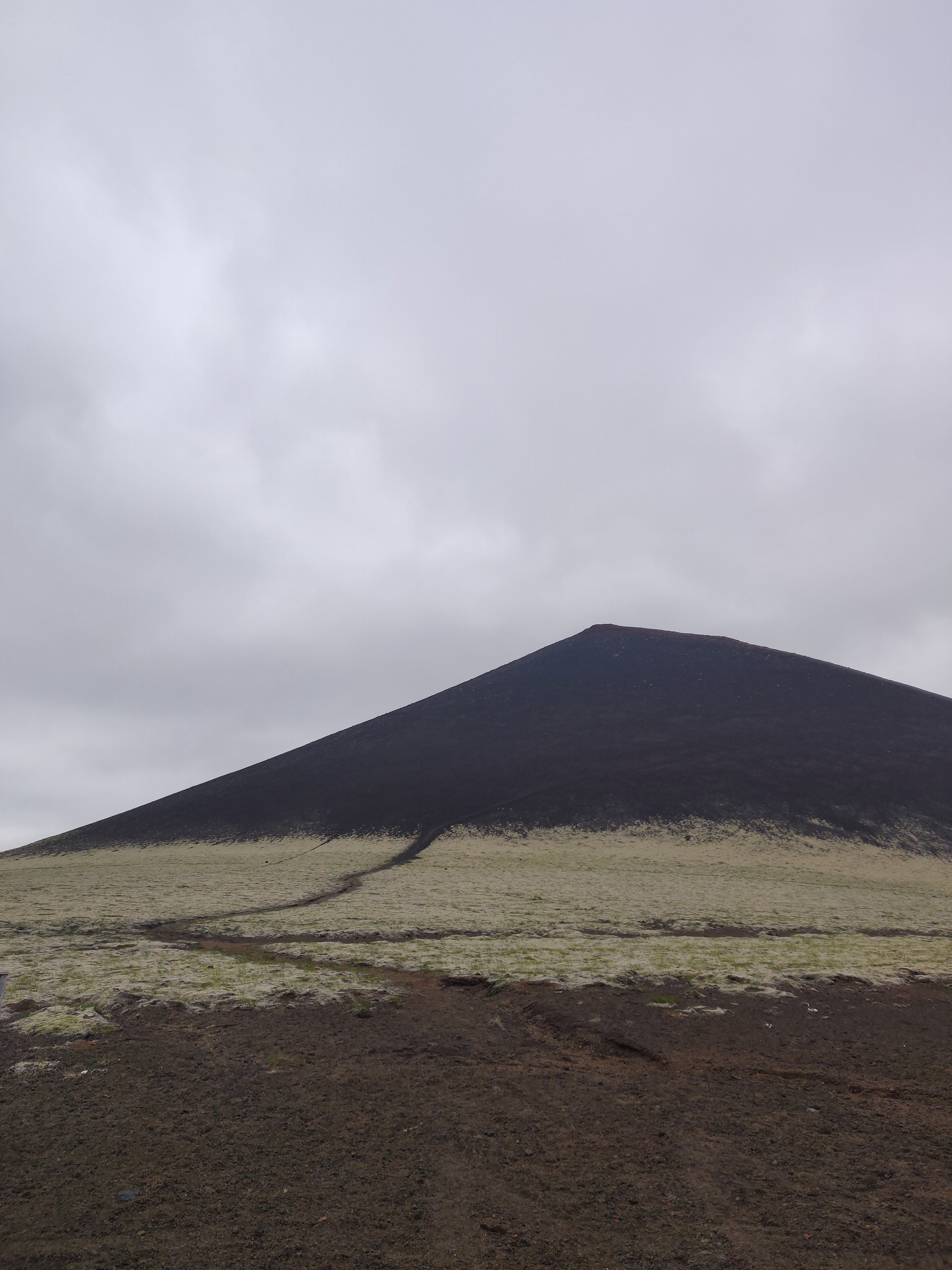
There’s a small path you can follow to reach the summit, but it’s quite a steep and slippery climb so make sure you have walking shoes if you plan on going up. Expect roughly 30 minutes to go up and down them safely.
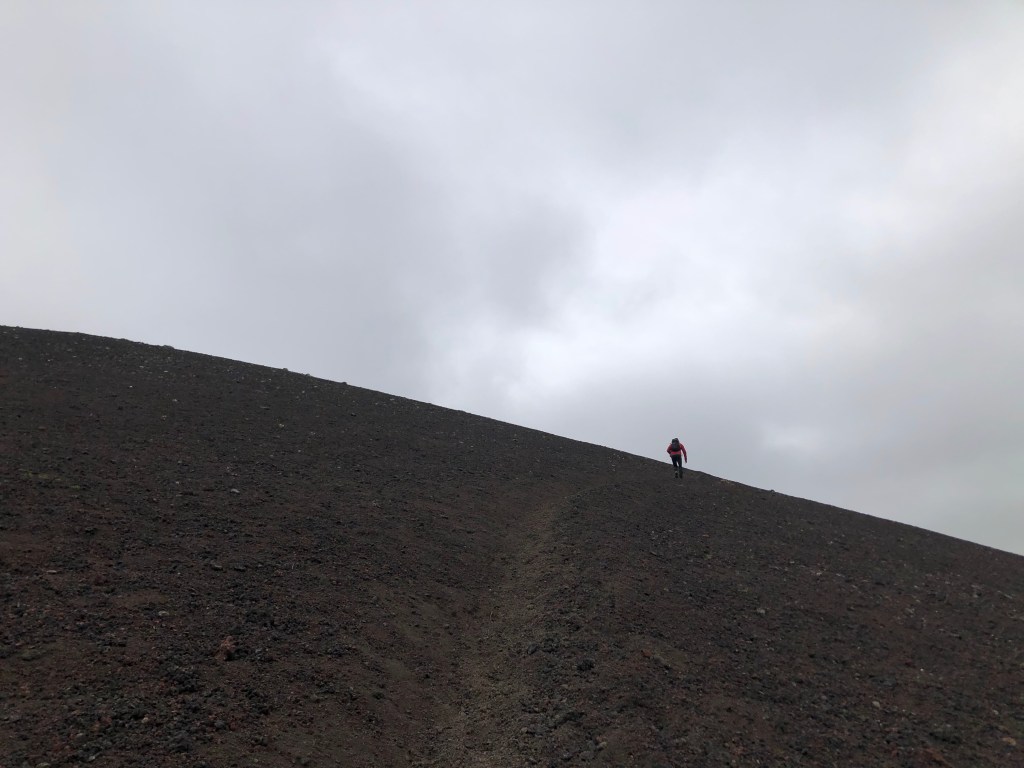
You’ll be rewarded for your efforts with the fact that you just climbed a volcano and an incredible panoramic view of the lava fields below.

Svörtuloft Lighthouse

This iconic lighthouse on the westernmost point of the peninsula has the interesting characteristic of actually having two names – from the sea it is called Svörtuloftaviti lighthouse, whereas from land it’s called Skálasnagaviti.

Perched on the basalt cliffs that tower over the Atlantic, Svörtuloft is hard to miss with its bright, orange color. As you drive towards the lighthouse, you can easily see it in the distance, even on a foggy day. The route that leads there follows a narrow dirt road that’s quite comfortable to drive.

On your way to Svörtuloft, you’ll pass by Skarðsvík beach which, on a nice day, is worth a stop to take in the fresh Atlantic air. Stay vigilant if you decide to go for a stroll on the beach, as the area is known for its powerful waves. If you can, it’s best to visit at low tide.

Ytri Tunga Beach

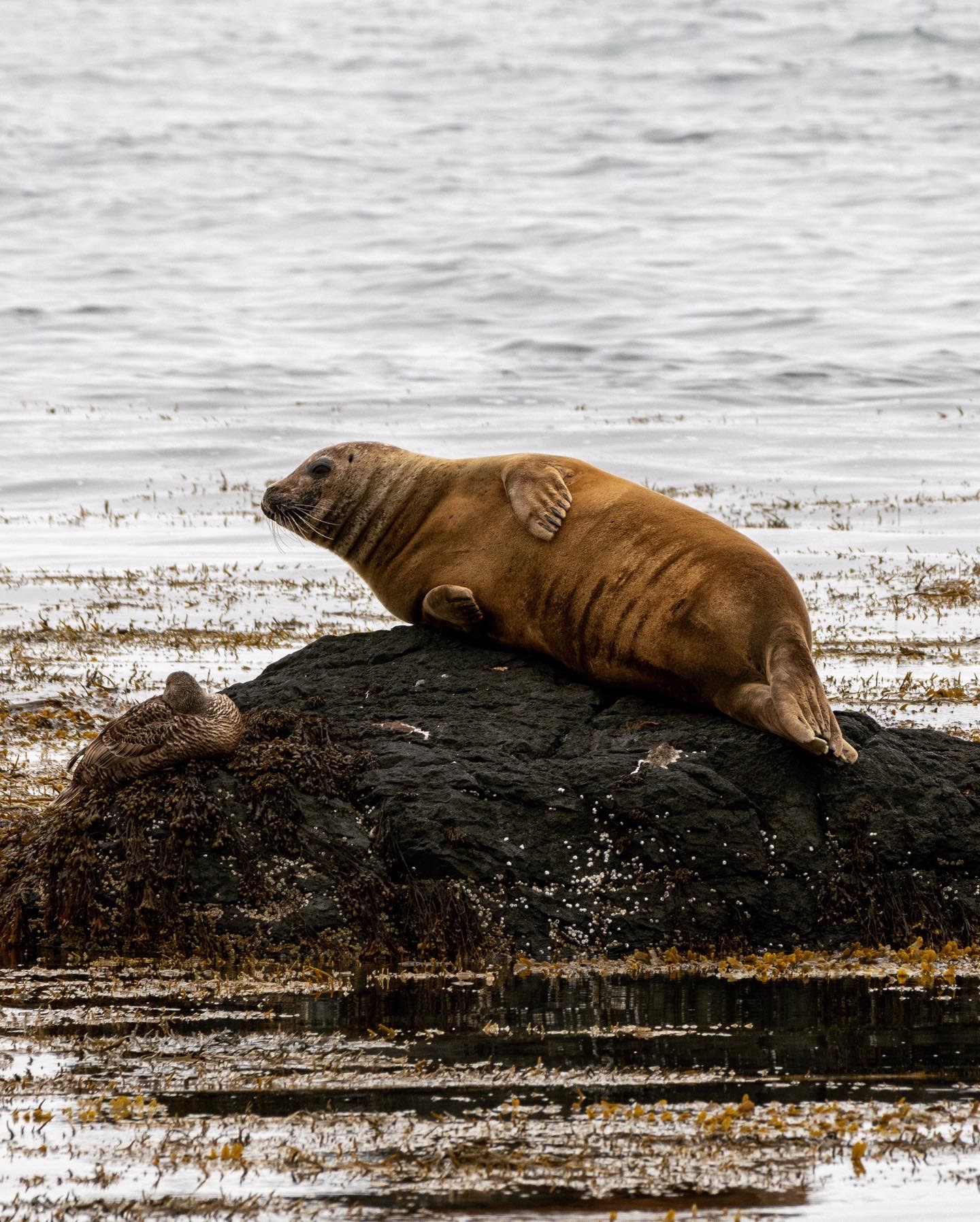
Let’s face it when it comes to wildlife in Iceland, you’re not likely to run into more than sheep and the odd Icelandic horse on your journey unless you’re lucky enough to spot the very elusive arctic fox. And although there’s nothing wrong with marveling at the beauty of the land, Ytri Tunga Beach is an opportunity to get to meet some of its inhabitants.

On this stretch of beach along the southern coast of the peninsula, you can observe harbor seals (or the common seal) and grey seals in their natural habitat, often lazing on the rocks or beaches. It’s incredible to get to see these creatures so close, but remember that we’re guests in their home, so please make sure to respect the rules of conduct outlined on the signage near the parking.

You’re most likely to see our chubby sea friends over the summer months, especially at low tide when they climb onto the rocks.
Rauðfeldsgjá Gorge

This immense gorge on the side of Mount Botnsfjall is a popular spot on a trip around the peninsula during the summer.

Walking from the car park to the entrance to the gorge takes about 10 minutes with a gentle climb. A small stream runs through the gorge so make sure you’re wearing walking shoes and it’s worth bringing some waterproof clothing for comfort.

As you enter the mouth of the gorge, you’ll notice the walls covered in a luscious green moss from the floor along all sides of the grotto, with a window to the sky overhead.

Although you can follow the narrow path upstream through the gorge, I don’t recommend doing so as the path becomes quite narrow and wet.

The gorge gets its name from the saga of Bárður Snæfellsás, whose statue you can see in Arnarstapi, and means Red-Cloak Rift. The first part of the saga follows the half-giant Bárður, who upon his death became the guardian spirit of the Snæfellsnes Peninsula.

The tale goes that Rauðfeldur, Bárður’s nephew, pushed his elder daughter onto an iceberg while playing which is said to have drifted all the way to Greenland. Although his daughter survived, in his fury Bárður cast Rauðfeldur and his brother Sölvi into the gorge as punishment.

Arnarstapi

Speaking of the tale of Bárður, you can marvel at a statue in his honor in the nearby town of Arnarstapi.

The statue of Bárður near Arnarstapi
watches over the peninsula as clouds roll over the mountain.

A lone house near the coast in Arnarstapi
perched on the basalt cliffs.

This small coastal village on the southern part of the peninsula was once a fishing hub due to the natural harbor, allowing settlers to fish the nearby waters rich in herring. Today, it’s a popular stop for tourists before heading to Snæfellsjökull National Park.

Arnarstapi proposes essential services for travelers exploring the peninsula, a wide array of accommodation options, and tour companies.

One of the most interesting features of Arnarstapi’s beaches is the stone arch that has been eroded by the unrelenting sea called Gatklettur.

Although the village itself is very charming and offers an amazing view of the whole coast from a viewing platform situated above the harbor, you’re going to want to take off and discover the nearby Snaefellsjokull National Park.

Snæfellsjökull National Park

This is one of only a handful of national parks in the country, which gives you a good sense of how impressive the area is. There are a number of great walks you can take along the coast and through the lava fields to get up close and personal with the rugged landscape of Snæfellsnes.

Below is a list of some of the most popular walks through the Snaefellsjokull National Park from AllTrails.

We’d initially planned to do the loop between Dritvík and Aflraunasteinar along the Djúpalónssandur black beach, but chose not to in the end due to poor weather conditions. If you’re braver than us, I hear the walk is equally beautiful in the rain, just make sure you’re properly equipped!

Instead, we took a short walk along the coast from Arnarstapi to Hellnar, just make sure you have walking boots as the path gets rocky in certain areas, and make sure you have something waterproof if it’s looking like a damp day.

Búðakirkja the Black Church

Is there anything more poetic than a charcoal-colored church in the middle of a lava field?

Búðakirkja is both beautiful and ominous, sporting a black mantle that gives it a distinctive appearance from the coating of the wood (pitch) which protects it from the harsh Icelandic conditions.

The church was initially built in 1703 but was eventually taken down due to the small number of parishioners. The church as seen today was built in 1987 and is used both for traditional church events for the parish, but also for other events like destination weddings, music events, and storytelling.
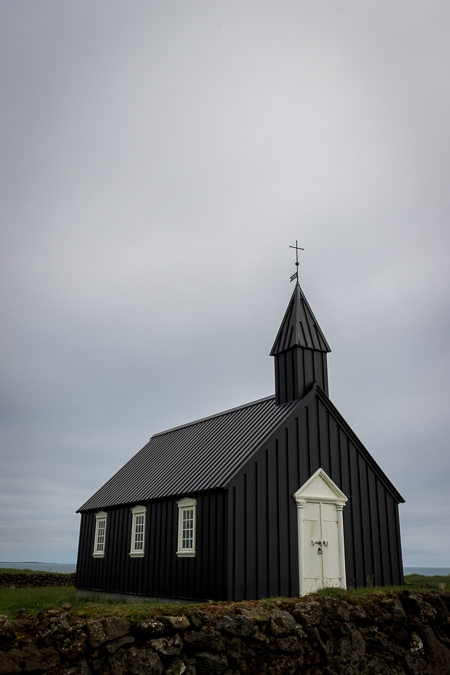
While you’re in the area, you can also visit the beautiful Bjarnarfoss waterfall that’s a short drive from the black church, on route 54. In fact, you can even see the waterfall in the background if you look at the church from its southern side.

Snæfellsjökull Glacier

Like much of the area, Snæfellsjökull shares the peninsula’s volcanic history. Indeed, this 700,000-year-old glacier-capped volcano sits on the tip of the peninsula and rises 1,446 meters above the sea.

The mountain is actually called ‘Snæfell’ (Snowy Mountain), while ‘jökull’ is the Icelandic word for “glacier”.

Accessing the glacier is only possible through the F570 road that traverses the peninsula between Ólafsvík in the north and Arnarstapi in the south. This was our first experience driving along an F road in Iceland and it was definitely a challenge.

The steep, rocky, foggy road made it difficult to climb with the full drive taking us over an hour to complete. I would absolutely recommend undertaking this drive with a 4-wheel drive car, even if we came across a couple of brave drivers attempting the climb in a 2-wheel drive.

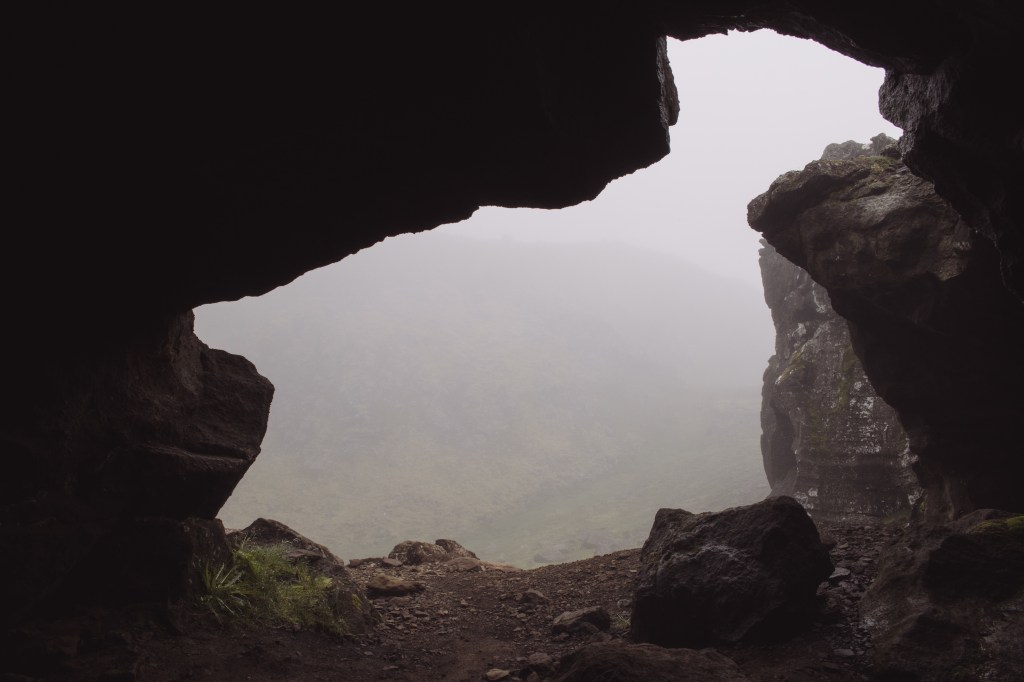
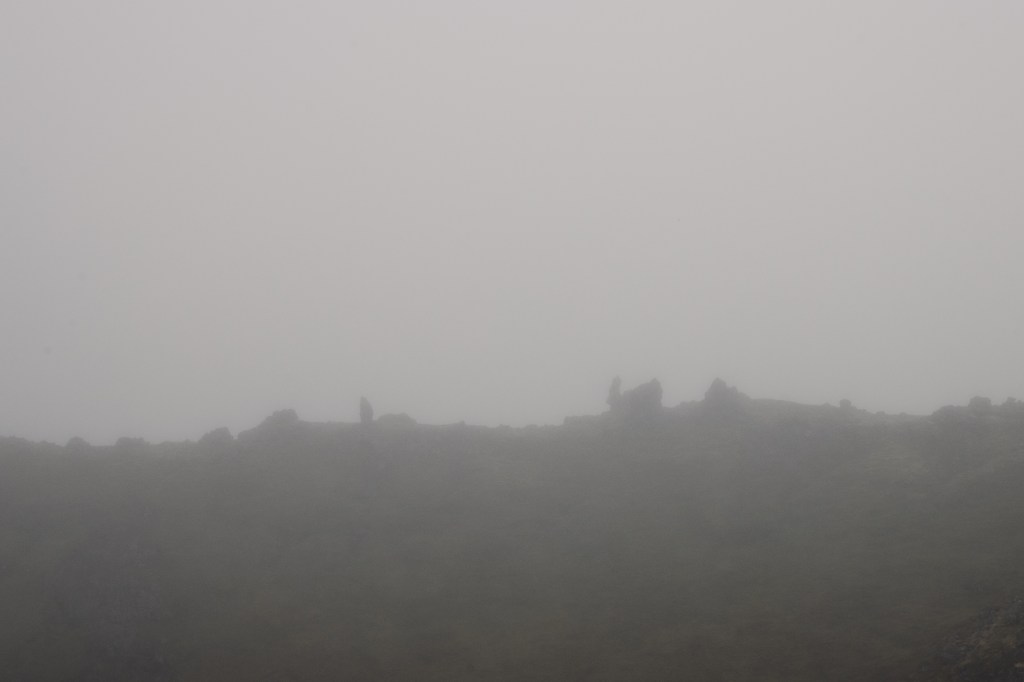
Shortly after you start along route F570 from Arnarstapi, you’ll come across Sönghellir, a small cave that’s a short walk from the main road. The fog didn’t only make our drive difficult, it also lent a very ominous atmosphere as we walked to the cave. The rocks lining the hills around us took the shapes of people, stalking us as we ventured deeper into their realm.
The appearance of people wandering
along the ridge above us, watching us as we approached the cave.

Inside Sönghellir cave
and the fog clouding the nearby hills.
As we progressed along the road over the highest part of the mountain, right next to the glacier, we eventually came out of this somber setting onto a much brighter scene.

If you’re feeling adventurous, there are a number of tour companies with whom you can book a glacier hike, definitely a once in a lifetime experience. You can typically go on these walks from May until September. On a clear, sunny day you’ll be greeted with an absolutely stunning panorama from the top of the glacier, looking down at the wide expanse of Snæfellsnes below you.

Having passed the glacier (without getting a good look at it sadly…) we made our way down towards Ólafsvík from Snæfellsjökull where we were greeted with bright blue skies and snow-covered black mountains.

The drive down was less challenging than the way up, however, you’ll still be faced with a steep, narrow dirt path to descend.

Selvallafoss

This hidden gem in the north of the peninsula, also known as the “Sheep’s Waterfall”, is a short drive after Kirkjufell. Although it’s less well-known than Kirkjufellsfoss, it’s equally beautiful but off the beaten track, so a lot calmer than the more popular spots.

Making your way from the car park to the waterfall, you’ll see an incredible panoramic view unfold before you in the shape of lava fields, extinct vents, and lake Selvallavatn.

One of the best things about Selvallafoss is that you can walk behind it! Indeed, if you follow the trail, you’ll be taken behind the waterfall to admire the water drizzle down from the rock above. Needless to say, you should wear waterproof clothing and walking boots are recommended as the rocks are covered in moss and slippery.

Ölkelduvatn Mineral Spring

Have you dreamt of finding the fountain of youth? A source of water so potent, possessing such incredible healing properties that it lives only in myth.

Now, what if I told you that you could drink from it, right here in the Snaefleness peninsula?

Ok, well…not quite. But the Ölkelduvatn Mineral Spring is supposed to have many therapeutic properties if you don’t mind the heavily carbonated taste of the water.

We came across this quirky little stop as we entered the peninsula on our way up from Reykjavik.
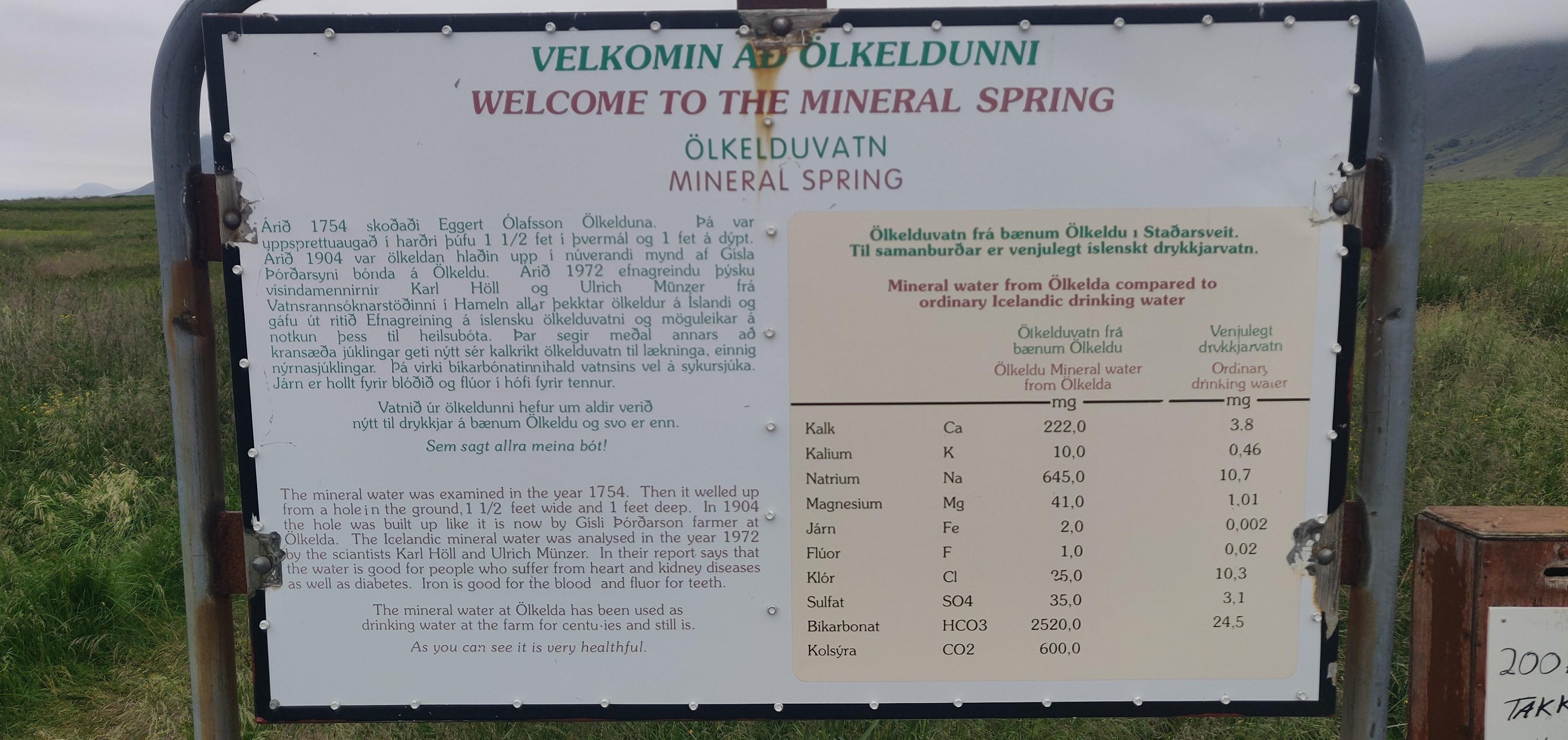
According to the signpost near the spring, the water possesses a much higher concentration of minerals than “ordinary” water, lending it curative properties. I’ll let you experience this for yourself and decide whether you felt any younger, or perhaps even a surge of immortality as you sipped on this rare beverage.

Golden Circle or Silver Trail

Our journey around Iceland starts with a more typical exploration of Reykjavik and its surrounding area with a day trip along the Golden Circle. Don’t worry though, we’ll explore the more remote parts of Iceland together soon, starting next week with the Snæfellsnes Peninsula.

Until then, let’s dive right into once of Iceland’s most popular attractions.

What is the Golden Circle?

The Golden Circle is a route that many tourists visiting Iceland go on from Reykjavik, or one of the nearby towns, covering the key locations over a day trip. The high-profile spots that are likely already on your list include:

  • Kerid crater
  • Gullfoss waterfall
  • Geysir and Strokkur
  • Þingvellir

These are the places where you’ll encounter most tourists as many local tour operators propose daytrips and excursions to them. So, if there’s somewhere on this list you want to see in a more intimate atmosphere, make sure you head there early in the day. We saw the most people at Gulfoss and the geyser fields.

A couple of these, and some of the extra stops below, require a small fee (between 400 to 800 ISK) to either access the area or park. This money goes towards preserving the beautiful ecosystem that you’ll be lucky enough to see throughout your trip and maintaining the infrastructure that allows you to access them.

Although we visited these main tourist attractions on our excursion, we also made a few stops along the way that don’t necessarily feature on your typical Golden Circle itinerary. Some of these were worth the detour, others not so much. But that’s the spirit of this blog – going out there and exploring new places for yourself.

  • Brúarfoss
  • Faxi
  • Urridafoss

The map below summarizes our itinrary from the Golden Circle expedition. Well technically we stopped at Bruarfoss (between Strokkur and Thinvellir) the day after, and I’ll explain why later.

So, let’s get started on our journey along the Golden Circle and get our first taste of Iceland!

Top things to see on the Golden Circle

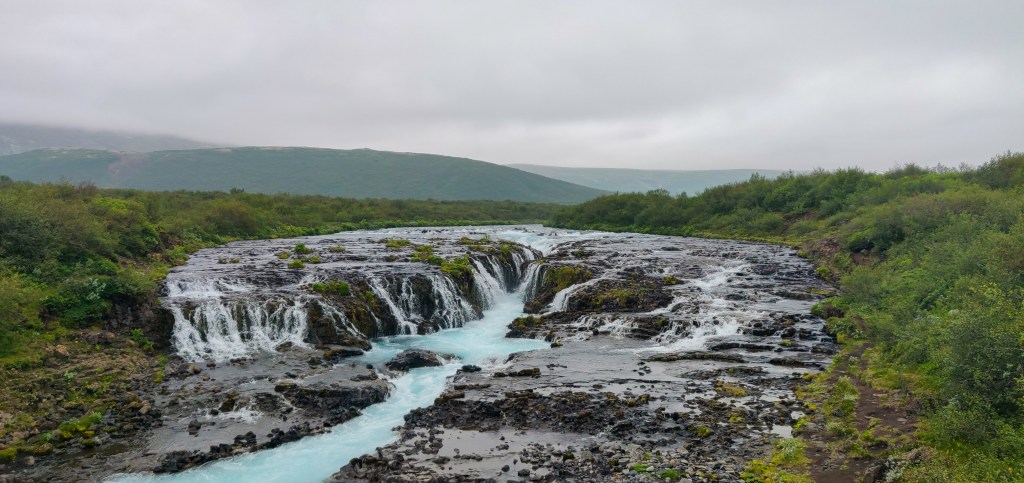
Brúarfoss

The Turquoise Waterfall

Well, technically we didn’t do Brúarfoss on the same day as our Golden Circle expedition…As we pulled into the small parking lot from which you can reach the waterfall, we were hit with the sudden, but all too obvious realization, that the walk to Brúarfoss was about an hour and a half each way. Yep…so much for planning.

You used to be able to access a parking much closer to the waterfall, which lay on private land. However, due to excessive tourism, and certain people sadly not showing this beautiful area the respect it deserves, access to this area was restricted. Now, you can only reach the waterfall through a hike, or journey by horseback ride if you prefer.

Before I get into the revitalizing walk along a turquoise river, dotted with small waterfalls and white water, and reaching the famous horseshoe shaped waterfall, let’s get some logistics out of the way.

The small car park I mentioned earlier can probably fit between ten and fifteen cars at best depending on their size. So, if you’re planning to visit Brúarfoss, I recommend getting there early in morning or later in the afternoon to avoid the potential rush of tourists. Although this spot isn’t as famous as Gullfoss (for reasons that elude me given its beauty) we did come across a few fellow explorers on the way.

The walk to Brúarfoss is very straightforward, with a clearly indicated and well-maintained path that follows the Brúara River. The vivid turquoise water gets its color from the Langjökull glacier where it originates from. Although Brúarfoss is definitely the reason you’re going to want to go on this hike, there are two other smaller waterfalls along the way that provide their own impressive display: Hlauptungufoss and Midfoss.

You can access a detailed map with the different waypoints of the hike on AllTrails by clicking on the picture below.

Once you get to Brúarfoss, there are a couple of viewpoints you can take, the first of which being at the level of the bridge. From there you can admire the horseshoe shape of the waterfall, creating a unique structure with the falls converging into a colorful blue basin at its base.

If you cross the bridge, you’ll see a small path on your left that seems to lead down to the banks of the river but actually takes you to a small viewing point under the bridge, large enough only for a couple of people to sit. It’s a beautiful and more intimate spot for you to admire the waterfall and take it all in.

Geysir and Strokkur

The steamy siblings

A real tourist hotspot, and not only because of the 80 to 100°C water that spouts from the ground in a steamy column of water, Geysir and Strokkur will probably be your first taste of Icelandic geothermal activity (although the water from natural geothermal springs that supply Reykjavik might count).

Now before you get too excited, Geysir which is the largest geyser at the geothermal field, is mostly inactive these days. Indeed, as its geothermal activity has calmed down, the dormant giant has gone into retirement and provides instead a serene display of turquoise water and orange shades of soil.

Its younger brother Strokkur on the other hand is very active, spitting columns of water up to 30 meters in the air every few minutes.

Time for a crash course in geyser science! As the water flowing through the underground channels meets hot bedrock and heats up, it starts building pressure. When the water has reached peak temperature and pressure, it explodes out from the geyser in a mix of boiling steam and spray.

In the seconds leading up to the explosion, you’ll see the water in the crater flow in and out, almost as if it were breathing (or sneezing…but that’s less poetic, although probably more accurate) before forming a huge bubble for a split second and exploding into the air.

If you get your timing right, you might even be able to snap a picture of that perfect moment before the bubble pops.

If you want to stretch your legs a little after patiently waiting to get your ideal picture, there is a short hike you can go on that leads up the hill that overlooks the geyser field. From this higher vantage point, you’ll get to see the full geothermal area in all its glory and admire Strokkur’s display in a less crowded atmosphere.

Þingvellir National Park

A historical place

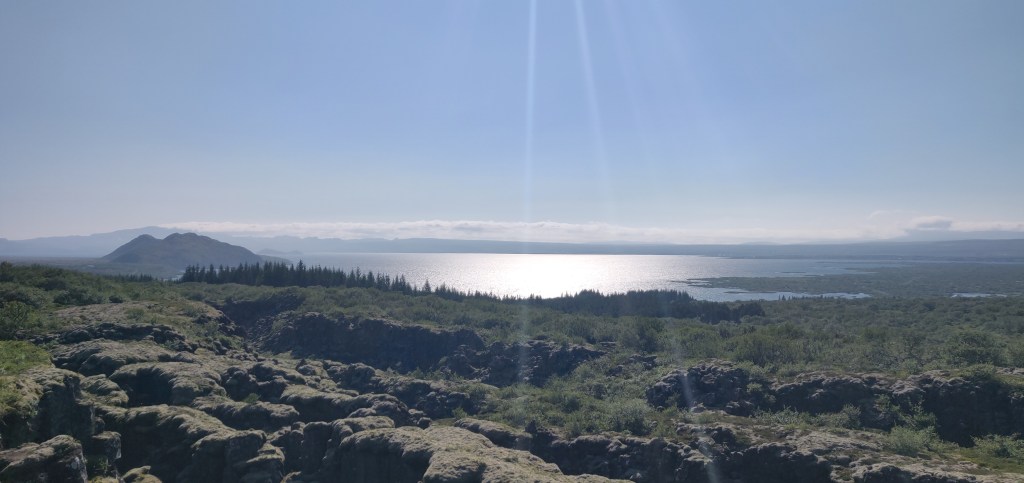
Þingvellir is situated in a rift valley that marks the crest of the Mid-Atlantic Ridge and the boundary between the North American and Eurasian tectonic plates, and spans across 240km2. The national park was designated a UNESCO World Heritage Site in 2004 for its historic significance and diverse flora.

The name Þingvellir (pronounced thingvellir) is derived from the old Norse Þingvǫllr, which is a combination of the words Þing (pronounced thing) that means “assembly”, and vǫllr which means “field”, giving us the “assembly fields”. Indeed, it was the site of the Alþing, the annual parliament of Iceland from the year 930 until the last session held in 1798.

There are a few things to do around Þingvellir including diving between two tectonic plates in the Silfra rift, taking a walk through the park up to the Öxarárfoss waterfall, or visiting the cultural center for an Icelandic history lesson. It’s also a popular area for hiking and horseback riding.

The park is breathtaking, and like much of Iceland’s landscapes, it forces you to review your sense of scale. The towering rock being pushed out of the ground by the power of the continental plates reminded me of The Wall in Game of Thrones minus the White Walkers (although you’ll see the odd pale tourist), stretching out as far as the eye can see. The whole valley seems to be tearing apart, as the continental plates that meet there move further apart every year (on average 2,5cm per year).

Whether you’re a history buff, a geology lover, or just a fan of marvelous landscapes, this is a must see on your trip.

To park at one of the five parkings availabl, you’ll have to pay a small fee depending on the kind of vehicle you’re driving. You can find out more information and a detailed map of the parking, walks and attractions on the Þingvellir National Park website.

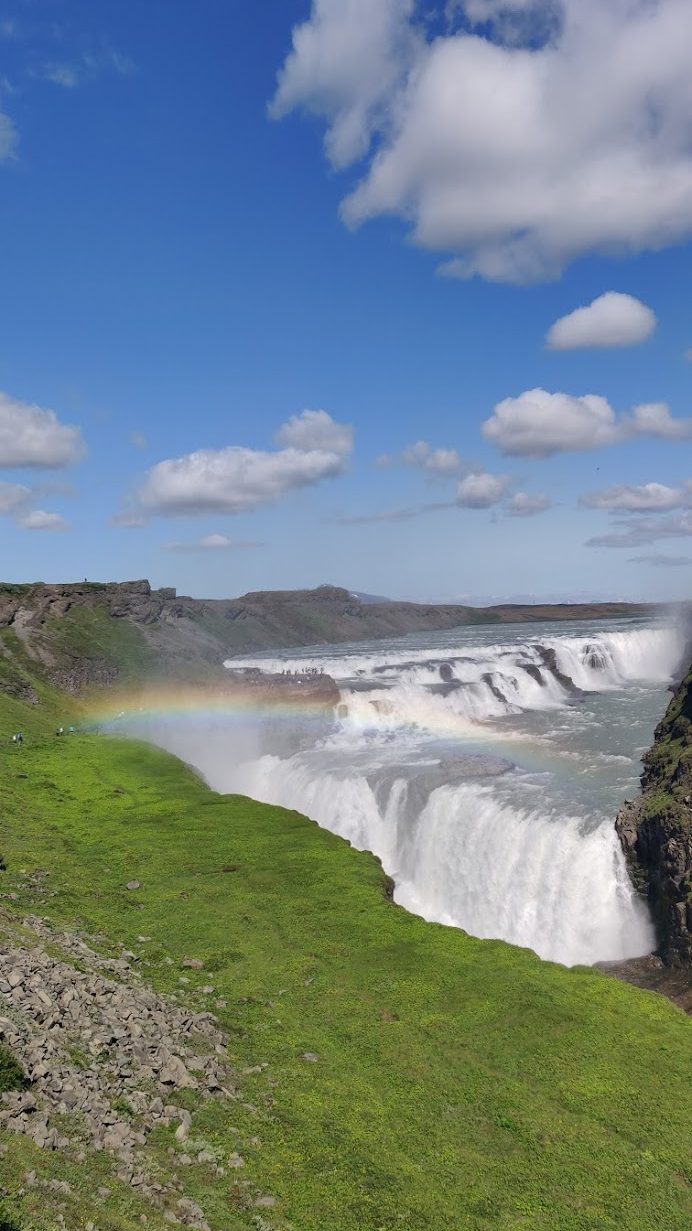
Gullfoss

The Golden Falls

On a sunny day, the waterfall is often ornate with a rainbow going from one bank to the other, lending a mystical touch to the place. Almost like the Bifröst, the bridge that connects Mitgard (Earth) to Asgard (the land of the gods) in Norse mythology.

The torrent of water seems to empty itself into the very bowels of the earth, digging the canyon that stretches out before it. Gullfoss really is one of the most beautiful waterfalls we saw on throughout our entire trip.

There are a few viewpoints from which you can see the waterfall, and most people tend to flock towards the one closest to the falls. Although it’s definitely worth going to see the golden falls up close to be showered in the spray and experience the deafening sound of the crashing water, the best view for us was the furthest viewpoint directly opposite the waterfall, which you can access from the parking through a staircase.

The parking is quite large, so you won’t have any trouble finding a spot, and rest assured there’s no fee this time. The only tribute you’ll have to pay is to take in the natural splendor this unique place has to offer.

Kerid

The Eye of the World

Our first stop on the Golden Circle was at Kerid Crater, which allowed us to get our legs warmed up for the day ahead. You can take a walk around the rim of the red crater and the small lake that lies in its center quite quickly, and there’s even a footpath near the starting point from where you can go down into the crater itself and the lake.

There’s a small fee of 400 ISK to visit the area which goes towards preserving it and the surroundings. You can pay by card at the small cabin near the parking, and children under 12 get to visit for free.

The walk itself and going down to the lake will probably take you around 30 minutes, but you mind end up staying longer, hypnotize by the blue eye that lies at the center of the crater’s red slopes.

Faxi and Urriðafoss

By now you might have guessed that “foss” is the Icelandic word for waterfall. Had you figured it out?

Throughout this blog series, you’ll see that we visited many waterfalls across the island (almost 40 if I’m not mistaken…). To be honest with you though, when it comes to Faxi and Urriðafoss, we didn’t see what all the foss was about (sorry for the pun…).

Let’s start with Faxi, where you’ll have to pay a 750 ISK fee to access the parking (I’m not sure if this is also an entrance fee for visiting the waterfall). The pathway leading to it is short and comfortable, and there is a café overlooking the waterfall if you fancy a warm drink. The waterfall itself is nothing spectacular, although it can be refreshing on a hot day as you can really get close to the water and enjoy the colling spray it provides.

As you can see from the itinerary I shared earlier, going to Urriðafoss will take you on a bit of a detour further south. Not a long detour mind you, but that’s half an hour you could probably spend better at another spot. The waterfall itself is quite nice, and it’s a popular spot for local fisherman. Beyond that, I would only recommend making the stop if you have some time on your hands or on your way around the ring road.

The “not so” Secret Lagoon

The Secret Lagoon is a popular stop on the Golden Circle tour, one that we chose to pass on in favor of other hot pool experiences. The geothermal pool located on route 30 near Reykjavik is meant to be the oldest in Iceland, dating back to 1891. An entrance of 3000 ISK per person (free for children and 2200 ISK for seniors) will give you access to the facilities including showers and a bistro for drinks and snacks. You can find all the details, including opening seasonal opening hours on their website.

If you do decide to stop for a dip in the lagoon, I suggest you do so at the end of the day, travelling clockwise along the Golden Circle by starting with Thingvellir, to enjoy a relaxing soak in the warm pool after a long day exploring.

Remember though, the lagoon is manmade, but if you want to discover truly wild geothermal pools, there are plenty of alternatives if you know where to look. One of which, and this was a highlight of the trip for us, was the Reykjadalur Hot Spring Thermal River, but that is a story for another time.

Our thoughts

As you can probably tell, our highlights of the Golden Circle were the two main waterfalls, Brúarfoss and Gullfoss, the geysers, and Þingvellir. All of which are situated along the stretch of road from route 35 to 37, making your Golden Circle more of a Silver Trail perhaps?

If you really want to make the most of these places and not end up rushing through them, you’ll need the full day. The walk to Brúarfoss and visiting Þingvellir alone will take you a good five hours (not counting driving between them), and you’ll probably spend more time than you realize mesmerized by the show Strokkur will put on for you.

We also found ourselves making quite regular stops to take in the scenery as we drove through Thingvellir National Park, as there are some beautiful viewpoints scattered along the way.

Kerid is certainly worth seeing if you have the time, after all you are in the land of ice and FIRE. It’d be a shame to not see at least one volcano, albeit an extinct one. However, if you’re headed to the Snæfellsnes Peninsula on your trip, as did we, you’ll be treated to much more spectacular volcanic views and get to see where Iceland gets its fiery reputation.

So, what’s on your Golden Circle tour? If you’ve already been, did you discover some unique stops along the way?

I’d love to hear from your experience, so please feel free to share what made your journey special in the comments below.

Until next time roamers!

A land of ice and fire…and sheep!

If you love the open road, breathtaking landscapes, and kamikaze sheep…you’re in for a treat. What a destination to kick off this blog’s first series, as we roam together through our most recent destination – Iceland.

I’ve rarely traveled somewhere and felt transported to another planet. From black lava fields covered in luscious green moss, barren martian canyons and lunar fields of volcanic ash, to millennial glaciers, this small island gathers just about every natural phenomenon you could imagine.

I’m thrilled to share with you our adventures as we explored this unique and incredible place! We travelled around the island over 14 days, covering 4,057km in our trusty four by four, and more than 212km on foot.

There’s no two ways about it: Iceland is a nature-lover’s dream!

Our journey to Iceland – third time’s a charm!

After three attempts, seemingly endless rebooking, and a year and a half since we started planning the trip, we finally made it to Iceland in July 2021. We decided to experience this beautiful country over a two-week road trip around the island’s famous ring road, with plenty of stops and detours along the way.

We flew from Nice to Reykjavik with a short layover in London in a day, and after going through border control and getting our rental car arrived in town early in the afternoon.

While we were planning this trip, we came across quite a few 8-day itineraries covering similar stops. However, I’m going to be very honest, I have NO IDEA how this is possible. I’m sure you could technically go around the island in 8 days, but I’d be prepared for a very hectic schedule and little wiggle room to explore.

To give you an idea, over the 14 days we were in Iceland, we’d usually be up and on the road by 8 or 9AM at the latest, and at the next stop by 9 or 10PM at the earliest. But hey, maybe I just need to work on my planning a bit!

Our journey started in Reykjavik, where we stayed for three nights to allow us plenty of time to get our bearings, discover the city and its surroundings, and go on our Golden Circle day trip. From there we drove to the Snæfellsnes Peninsula (Ólafsvík) in the West, made a stop along the North coast in Blönduós on our way to Akureyri, where we stayed for two nights.

After recharging our batteries, we took on a long drive along the North coast to Vopnafjörður in the Northeast, which was probably the most tiring drive of the trip. From there we hit the Eastfjords where we stayed in a lovely cottage overlooking the fjord in Solbrekka, before hitting the south coast, starting with Höfn (pronounced Hop). We then drove to Hof (pronounced Hof) a little further down the coast, and yes those are different towns, before making our way to Vik, and going full circle near Reykjavik the following day.

You can find the full breakdown of this itinerary in the trip section of the blog.

When to go?

So, your mind’s made up – you’re going to Iceland!

One of the first things you’re probably asking yourself is when to go.

Choosing when to travel to Iceland is quite important as it can determine the kind of things you can do and the places you can visit. For the sake of simplicity, I’ll focus on the peak and off season for this first post.

Peak season – June to August

Our trip to Iceland took place in the middle of July, but bear in mind that this was in COVID times. So, although we came across many tourists, this probably doesn’t reflect a peak season under normal circumstances.

That being said, most of the international tourists we encountered tended to gravitate towards the capital region and the southern coast. We met more locals the further north we went, except for large cities like Akureyri which are also popular destinations.

Although the weather was quite changeable, the temperature remained pretty constant, and we only had a couple of days of rain. So, as long as you make sure to pack something waterproof and windproof, and have plenty of layers, you’ll be fine.

The great thing about Iceland is that all types of weather just suit it. On our second day, as we returned to Reykjavik from our Golden Circle trip, we went from bright sun and clear blue skies to grey and foggy mountain ranges in just a few minutes. This gives the area a unique atmosphere, almost as if the mood of the island is changing throughout the day.

Driving through Thingvellir National Park on a sunny day…
and on a grey day. Different mood, equally beautiful!

Speaking of driving, the roads are extremely easy to navigate and are well maintained overall, so you’ll have no trouble getting around in summer. You’ll normally only encounter dirt paths or less well-maintained roads as you get further from the ring road, notably in the North and East. But I’ll do a deep dive into this topic in another post.

ProsCons
Better weather, warmer temperatures, longer days, easier to driveLots of tourists, expensive
Off season – September to May

When it comes to going to Iceland in the off season, I can only base my impressions on what I read while planning our trip and speaking to a few locals. So, if you’ve been during the off season, I’d love to hear from you and get your impressions!

Let’s get the obvious out of the way – going during the off season will be cheaper and you’ll run in to fewer tourists. So, if you’re planning to hit the Golden Circle and some of the other tourist hotspots, now’s the time.

Going early in the fall or later in the spring are good alternatives, as you’ll get decent weather and still be able to get to most places. Winter, however, is when things tend to get a little trickier, as accessing certain more remote areas of the island might be difficult.

Indeed, Iceland is as beautiful as it can be dangerous, with large areas remaining inaccessible at certain times of the year due to the harsh weather conditions. You can find all the details about this on the Iceland Road and Coastal Administration’s website and on SafeTravel Iceland.

We’d initially planned on going to Iceland at the end of winter as we believed this would give us a chance to see the Northern Lights. And who wouldn’t want to see that, right?

However, after much discussion we advised it against it, as we wanted to focus our trip on visiting the whole island instead.

But hey, if your mind’s really set on seeing the Aurora Borealis in summer, you can head to the Perlan Museum in Reykjavik for a virtual experience!

ProsCons
Fewer tourists, cheaper, a chance to see the Northern lights, winter wonderlandCertain areas aren’t accessible, can be difficult to drive, short days

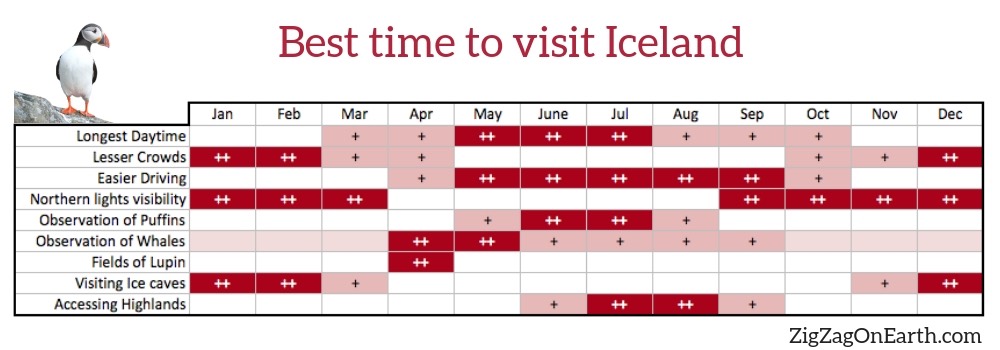
During my research I came across a great infographic by ZigZagOnEarth which provides an excellent summary of the monthly conditions.

Image by ZigZagOnEarth via https://www.zigzagonearth.com/best-time-to-visit-iceland/

In a nutshell, if this is your first time in Iceland and you want to have a good mix of exploration but also hit some of the must-see locations, I’d suggest going either in May or September. You can get a feel for which parts of Iceland you prefer and want to see more of, because believe me, even in 14 days, there is a lot more we wanted to do.

Where to go?

Great, you know when you’re going. Now let’s figure out where to go!

There are plenty of routes you can take to discover Iceland depending on how much time you have and your budget. However, many travelers tend to follow the ring road which goes full circle around the island, covering most of the big areas you MUST see one your first trip there.

This next tip may sound a bit weird, but I really recommend doing the ring road counterclockwise from Reykjavik. Although there are some amazing sites to see along the southern coast like Diamond Beach, the countless waterfalls, the glacier tongues that stretch for miles, and black sand beaches this is probably also where you’ll find most tourists. Because of this, the area feels a little less wild and you’ll run into large crowds quite frequently.

I will say though, this area is home to one of my favourite spots in Iceland so far – Mulagljufur Canyon. More to come on this hidden gem…

Another popular alternative, especially for travelers in transit or staying for a shorter duration, is the south coast and area around Reykjavik. Many of Iceland’s feature spots are on the Golden Circle and dotted along the coast.

But that’s not what you’re here for, so let’s get into it!

Depending on how long you’re planning on staying, the places you’ll likely have to be a bit more selective with are:

  • the Snaefelsness Peninsula
  • the Westfjords
  • the Highlands
  • the Eastfjords
  • some remote parts of the North

The reason for this is simply because getting to these areas can take time, and you don’t want to underestimate how long it can take you to drive from one place to another.

A good tip someone gave me before going was to account for about 10% more time than whatever your GPS tells you. This allows you to factor in speed limits, dirt or gravel roads, getting lost (as we did…more than once), and the all too frequent kamikaze sheep lining the roads.

I’ll be dedicating a few articles to some of these later in the series, so stay tuned to explore which one is right for you!

I hope you enjoyed this first article of the Iceland series and that it’s started to give you a little inspiration for planning your trip there, and if you’ve already been I’d love to hear from you.

Until next time roamers!

The adventure begins!

Welcome to the ROAMWITH travel and photography blog! I hope you’ll enjoy the stories, tips & tricks and media I’ll be sharing here, and maybe even provide a little inspiration for your next adventure.

In this blog, you’ll be able to find details itineraries from my past trips, including locations, accommodation, transport, logistics, and other fun tools for you avid travel planers out there.

A fair warning though, I will not share absolutely everything. To roam is to travel without necessarily having a clear idea of where you’re going. It means adventure, discovery
There are a few places, some hidden gems let’s say, that I’ll show you here. But it’ll be up to you to go out and search for them. After all, this is the essence of ROAMWITH!

Nice to meet you!
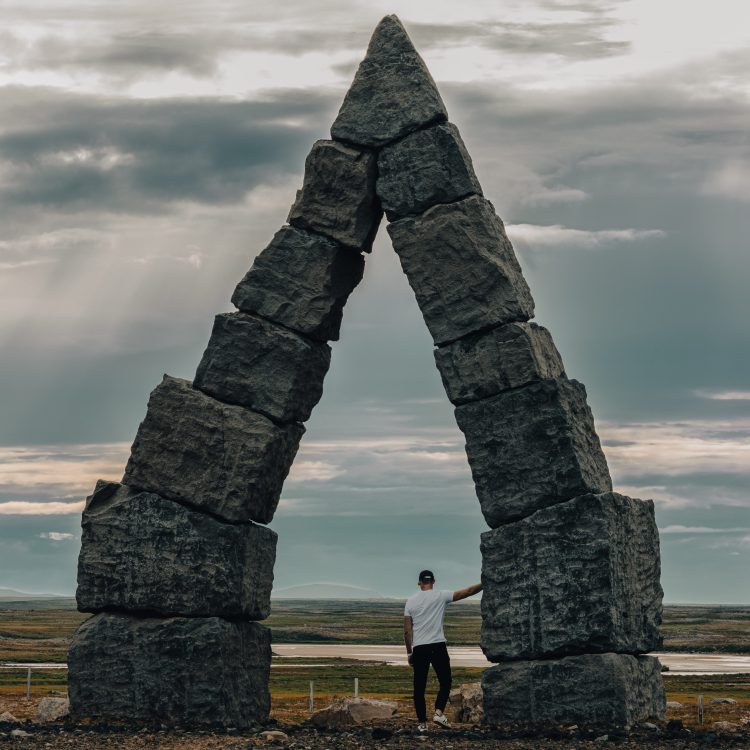
Arctic Henge, Iceland, July 2021

I’m James, a 28 year-old travel enthusiasts obsessed with discovering new places and meeting people.

By sharing my stories I want people to connect with each other and this beautiful world we live in. The feeling of discovering new places, meeting new people can’t be replicated, but by sharing our stories we can already take a step closer.

I’m a travel nut obsessed with the pursuit of the new and connecting with people from all walks of like.

Join me on an adventure

ROAMWITH is a projet that’s been close to my heart for a while now, and finally today’s the day!

Like many people, I found myself with a lot of time during THE PANDEMIC *dum dum duuum* to ruminate. And although I must admit I spent too much time zombyfied out in front of Netflix and abusing the order button on UberEats, I did realise a few things.

One of these realisations was that there are three things I absolutely LOVE.

Exploring, Connecting with people, and Learning.

I’d even go as far as to say that these three words encapsulate perfectly roamwith.