
If you love the open road, breathtaking landscapes, and kamikaze sheep…you’re in for a treat. What a destination to kick off this blog’s first series, as we roam together through our most recent destination – Iceland.
I’ve rarely traveled somewhere and felt transported to another planet. From black lava fields covered in luscious green moss, barren martian canyons and lunar fields of volcanic ash, to millennial glaciers, this small island gathers just about every natural phenomenon you could imagine.
I’m thrilled to share with you our adventures as we explored this unique and incredible place! We travelled around the island over 14 days, covering 4,057km in our trusty four by four, and more than 212km on foot.
There’s no two ways about it: Iceland is a nature-lover’s dream!
Our journey to Iceland – third time’s a charm!

After three attempts, seemingly endless rebooking, and a year and a half since we started planning the trip, we finally made it to Iceland in July 2021. We decided to experience this beautiful country over a two-week road trip around the island’s famous ring road, with plenty of stops and detours along the way.
We flew from Nice to Reykjavik with a short layover in London in a day, and after going through border control and getting our rental car arrived in town early in the afternoon.
While we were planning this trip, we came across quite a few 8-day itineraries covering similar stops. However, I’m going to be very honest, I have NO IDEA how this is possible. I’m sure you could technically go around the island in 8 days, but I’d be prepared for a very hectic schedule and little wiggle room to explore.
To give you an idea, over the 14 days we were in Iceland, we’d usually be up and on the road by 8 or 9AM at the latest, and at the next stop by 9 or 10PM at the earliest. But hey, maybe I just need to work on my planning a bit!
Our journey started in Reykjavik, where we stayed for three nights to allow us plenty of time to get our bearings, discover the city and its surroundings, and go on our Golden Circle day trip. From there we drove to the Snæfellsnes Peninsula (Ólafsvík) in the West, made a stop along the North coast in Blönduós on our way to Akureyri, where we stayed for two nights.
After recharging our batteries, we took on a long drive along the North coast to Vopnafjörður in the Northeast, which was probably the most tiring drive of the trip. From there we hit the Eastfjords where we stayed in a lovely cottage overlooking the fjord in Solbrekka, before hitting the south coast, starting with Höfn (pronounced Hop). We then drove to Hof (pronounced Hof) a little further down the coast, and yes those are different towns, before making our way to Vik, and going full circle near Reykjavik the following day.
You can find the full breakdown of this itinerary in the trip section of the blog.
When to go?
So, your mind’s made up – you’re going to Iceland!
One of the first things you’re probably asking yourself is when to go.
Choosing when to travel to Iceland is quite important as it can determine the kind of things you can do and the places you can visit. For the sake of simplicity, I’ll focus on the peak and off season for this first post.
Peak season – June to August
Our trip to Iceland took place in the middle of July, but bear in mind that this was in COVID times. So, although we came across many tourists, this probably doesn’t reflect a peak season under normal circumstances.
That being said, most of the international tourists we encountered tended to gravitate towards the capital region and the southern coast. We met more locals the further north we went, except for large cities like Akureyri which are also popular destinations.
Although the weather was quite changeable, the temperature remained pretty constant, and we only had a couple of days of rain. So, as long as you make sure to pack something waterproof and windproof, and have plenty of layers, you’ll be fine.
The great thing about Iceland is that all types of weather just suit it. On our second day, as we returned to Reykjavik from our Golden Circle trip, we went from bright sun and clear blue skies to grey and foggy mountain ranges in just a few minutes. This gives the area a unique atmosphere, almost as if the mood of the island is changing throughout the day.
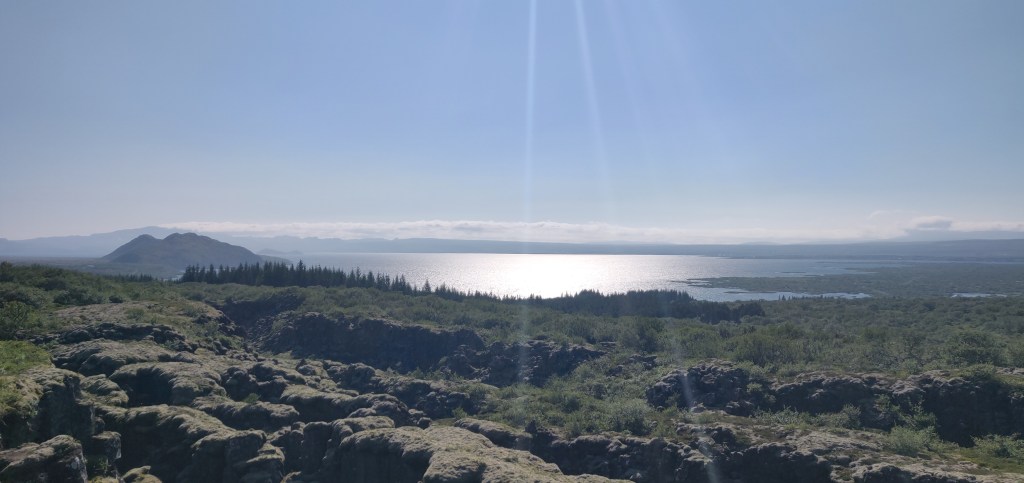

Speaking of driving, the roads are extremely easy to navigate and are well maintained overall, so you’ll have no trouble getting around in summer. You’ll normally only encounter dirt paths or less well-maintained roads as you get further from the ring road, notably in the North and East. But I’ll do a deep dive into this topic in another post.
| Pros | Cons |
|---|---|
| Better weather, warmer temperatures, longer days, easier to drive | Lots of tourists, expensive |
Off season – September to May
When it comes to going to Iceland in the off season, I can only base my impressions on what I read while planning our trip and speaking to a few locals. So, if you’ve been during the off season, I’d love to hear from you and get your impressions!
Let’s get the obvious out of the way – going during the off season will be cheaper and you’ll run in to fewer tourists. So, if you’re planning to hit the Golden Circle and some of the other tourist hotspots, now’s the time.
Going early in the fall or later in the spring are good alternatives, as you’ll get decent weather and still be able to get to most places. Winter, however, is when things tend to get a little trickier, as accessing certain more remote areas of the island might be difficult.
Indeed, Iceland is as beautiful as it can be dangerous, with large areas remaining inaccessible at certain times of the year due to the harsh weather conditions. You can find all the details about this on the Iceland Road and Coastal Administration’s website and on SafeTravel Iceland.
We’d initially planned on going to Iceland at the end of winter as we believed this would give us a chance to see the Northern Lights. And who wouldn’t want to see that, right?
However, after much discussion we advised it against it, as we wanted to focus our trip on visiting the whole island instead.
But hey, if your mind’s really set on seeing the Aurora Borealis in summer, you can head to the Perlan Museum in Reykjavik for a virtual experience!
| Pros | Cons |
|---|---|
| Fewer tourists, cheaper, a chance to see the Northern lights, winter wonderland | Certain areas aren’t accessible, can be difficult to drive, short days |
During my research I came across a great infographic by ZigZagOnEarth which provides an excellent summary of the monthly conditions.
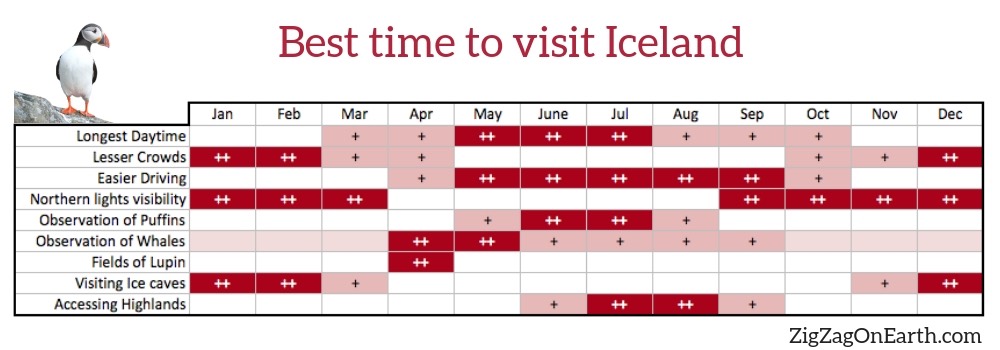
In a nutshell, if this is your first time in Iceland and you want to have a good mix of exploration but also hit some of the must-see locations, I’d suggest going either in May or September. You can get a feel for which parts of Iceland you prefer and want to see more of, because believe me, even in 14 days, there is a lot more we wanted to do.
Where to go?
Great, you know when you’re going. Now let’s figure out where to go!
There are plenty of routes you can take to discover Iceland depending on how much time you have and your budget. However, many travelers tend to follow the ring road which goes full circle around the island, covering most of the big areas you MUST see one your first trip there.
This next tip may sound a bit weird, but I really recommend doing the ring road counterclockwise from Reykjavik. Although there are some amazing sites to see along the southern coast like Diamond Beach, the countless waterfalls, the glacier tongues that stretch for miles, and black sand beaches this is probably also where you’ll find most tourists. Because of this, the area feels a little less wild and you’ll run into large crowds quite frequently.
I will say though, this area is home to one of my favourite spots in Iceland so far – Mulagljufur Canyon. More to come on this hidden gem…
Another popular alternative, especially for travelers in transit or staying for a shorter duration, is the south coast and area around Reykjavik. Many of Iceland’s feature spots are on the Golden Circle and dotted along the coast.
But that’s not what you’re here for, so let’s get into it!
Depending on how long you’re planning on staying, the places you’ll likely have to be a bit more selective with are:
- the Snaefelsness Peninsula
- the Westfjords
- the Highlands
- the Eastfjords
- some remote parts of the North
The reason for this is simply because getting to these areas can take time, and you don’t want to underestimate how long it can take you to drive from one place to another.
A good tip someone gave me before going was to account for about 10% more time than whatever your GPS tells you. This allows you to factor in speed limits, dirt or gravel roads, getting lost (as we did…more than once), and the all too frequent kamikaze sheep lining the roads.
I’ll be dedicating a few articles to some of these later in the series, so stay tuned to explore which one is right for you!
I hope you enjoyed this first article of the Iceland series and that it’s started to give you a little inspiration for planning your trip there, and if you’ve already been I’d love to hear from you.
Until next time roamers!
 ROAMWITH